
Installing current transformers

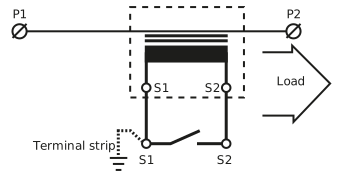
Installation direction
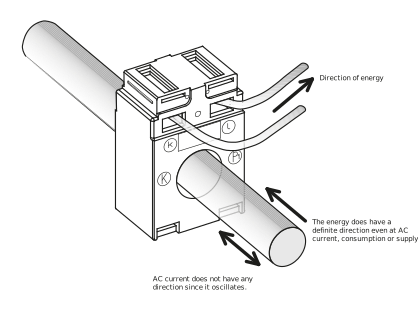
Determine the direction of energy flow in the cable on which you want to measure. P1 indicates the side on which the power source is located, while P2 designates the consumer side.
Terminals S1/S2 (k/l)
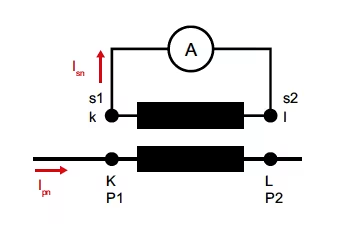
The connections of the primary winding are labeled "K" and "L" or "P1" and "P2" and the connections of the secondary winding are labeled "k" and "l" or "S1" and "S2". The polarity must be such that the "energy flow direction" runs from K to L.
Swapping the S1/S2 terminals leads to incorrect measurement results and can also lead to incorrect control performance in Emax and PFC systems
Important: Observe the data sheets and the marking on the rating plate, as the polarity may vary depending on the model



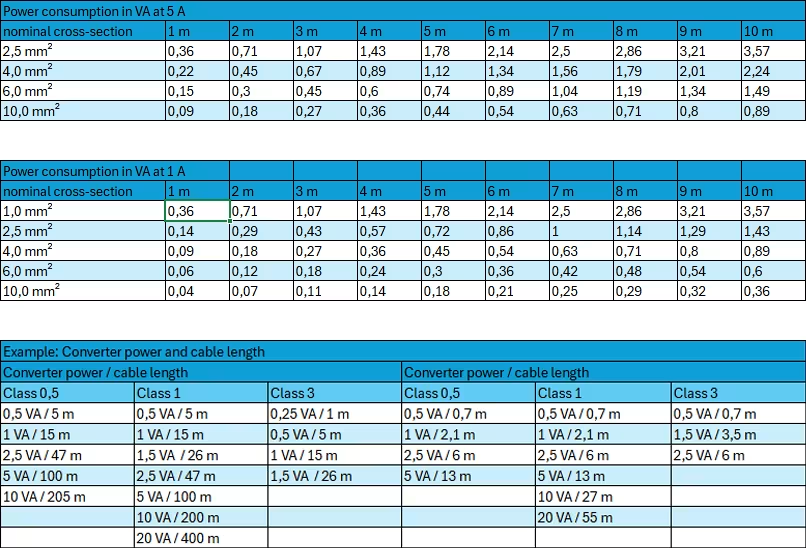
Cable length and cross section
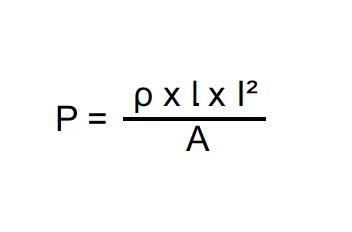
The power consumption (in W) caused by line losses is calculated as follows:
specific resistance for CU: 0.0175 Ohm *mm² / m for AI: 0.0278 Ohm * mm² / m l = cable length in m (outgoing and return cable) I = current in amperes A = cable cross section in mm²
Quick overview (power consumption Cu cable) for 5 A and 1 A
For every 10 °C change in temperature, the power consumed by the cables increases by 4%.

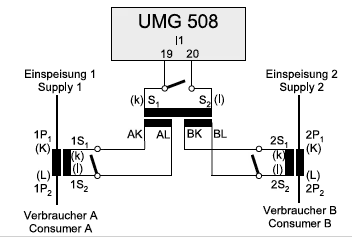
Series connection of measurement devices to a current transformer
Pv = UMG 1 + UMG 2 +....+ PCable + PTerminals. ...?

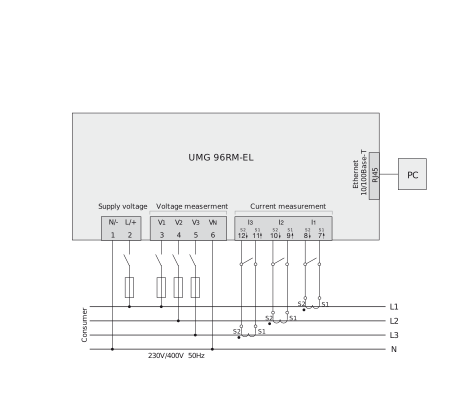
Parallel operation / summation current transformer
If the current is measured via two current transformers (e.g. 2 transformers), the total ratio of the current transformers must be programmed in the measurement device.
Example: Both current transformers have a transformation ratio of 1,000 / 5 A. The summation measurement is carried out with a 5+5 / 5 A summation current transformer.
The UMG must then be set as follows:
Primary current: 1,000 A + 1,000 A = 2,000 A secondary current: 5 A

Grounding of current transformers
According to DIN EN 61869-1, the housing of current transformers must be grounded if they are installed at ground potential. The following requirements apply to the secondary current circuit:
Low-voltage systems (≤ 1 kV)
Secondary circuits of current transformers in low-voltage systems must not be grounded, unless proper metering requires a connection to earth.
Medium- and high-voltage systems (> 1 kV)
In medium- and high-voltage systems, the secondary circuits of inductive current transformers must be grounded or routed through a grounded metallic shield.
(EN IEC 61936-1)
If the secondary circuit is grounded, the grounding must be made at a single point, typically at S1 (k) or at the corresponding grounding terminal. Multiple grounding points must be avoided.
Use of protection transformers
If a measurement device is retrofitted and only a protective core is available, we recommend using a 5/5 winding current transformer to decouple the protective core.