
Our Measures to Reduce Greenhouse Gas Emissions
Measures already implemented demonstrate how Janitza is reducing emissions step by step.
Our energy measurement devices provide full transparency into energy flows. This is the essential foundation for reducing greenhouse gas emissions. Energy transparency provides clear, reliable data, helping to quantify a complex topic and make it easier to understand. This allows us to see where we stand, identify opportunities for improvement and make important decisions today that will shape the future.
Would you like to find out how Janitza measurement technology can support your carbon footprint calculations?


Our commitment
“Our goal is to significantly reduce our greenhouse gas emissions by 2030, primarily through energy efficiency and conservation measures. As part of our climate strategy, we also support certified climate action projects.”
Alexander Veidt, Managing Director of Janitza electronics GmbH


Our Path to Decarbonisation
We systematically track our greenhouse gas emissions and reduce them through targeted measures. In doing so, we combine climate action and resource conservation with transparent processes. We continuously review and develop our measures to create a clear, traceable framework and progressively reduce emissions and our environmental impact.


Transparency on Greenhouse Gas Emissions
Systematically recording and analysing emissions provides an essential basis for identifying suitable reduction measures and transparently tracking progress. That is why we collect relevant consumption data and systematically evaluate the associated emissions.
Drawing on our expertise in energy technology and our certified energy management system, we have been able to record and analyse Scope 1 and Scope 2 emissions in detail since 2013. For Scope 3, Janitza works with ClimatePartner to quantify and assess emissions across the value chain as accurately and reliably as possible.


Set goals, implement measures
Based on the emissions data collected, Janitza sets targets for the gradual reduction of greenhouse gas emissions across Scope 1, Scope 2 and Scope 3. The aim is to reduce emissions as far as possible while continuously improving and expanding existing measures.
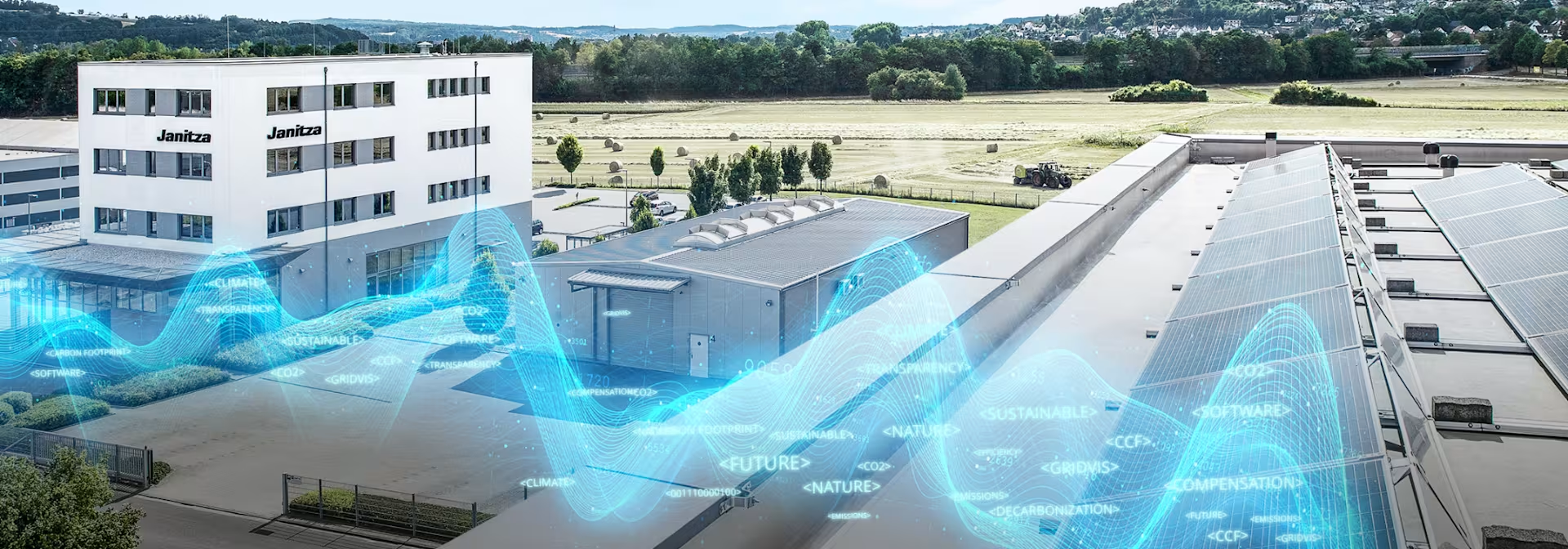
The focus is on practical operational and organisational measures. These include, for example, expanding the use of photovoltaic systems, further developing the company vehicle fleet and reducing the consumption of resources such as paper in day-to-day operations.
Janitza has already implemented a range of measures to reduce emissions. At the same time, the company continues to identify further opportunities for savings and uses these insights to develop additional reduction measures.


Certification and Climate Action Projects
Janitza has its Corporate Carbon Footprint (CCF) certified annually by ClimatePartner.
Janitza transparently reports greenhouse gas emissions that cannot be avoided and provides clear context for these emissions. This is based on robust emissions calculations and a clearly documented methodology. Janitza also provides transparent information on the supporting evidence and processes used.
For unavoidable greenhouse gas emissions resulting directly from its operations, Janitza supports certified climate action projects.
On the path to a positive climate contribution
We implement a wide range of specific and consistent measures to make a positive climate contribution and actively help shape a sustainable future.
Partnerships and cooperations
To further develop our climate strategy, Janitza works with a range of partners and service providers. This enables us to improve data transparency, continuously refine our measures and establish a robust foundation for our emissions reduction activities.
VEA der Bundesverband der Energie-Abnehmer e.V.: as an energy consultant for SMEs
VEA initiative for climate-friendly SMEs: supports SMEs in becoming more climate-friendly and saving CO2.
Reginee - the VEA's REGIonal Network for Energy Efficiency and Climate Protection: an association of regional companies with the aim of reducing CO2 emissions, sustainably lowering energy costs, and moving towards climate neutrality
The Climate Protection Business Network: an IHK platform for companies that actively contribute to climate protection and want to continuously improve their climate protection expertise, in cooperation with LEA (State Energy Agency of Hesse)




Employee participation
Reducing emissions across the company requires the active involvement of our employees. Their contribution is essential to implementing measures in day-to-day operations and embedding lasting change throughout the organisation.
Jobbike
Janitza supports the JobBike scheme. Together, our employees cycle around 15,000 km each year. The scheme is part of our efforts to promote lower-emission mobility in everyday working life.
Digitalization
By reducing paper use and promoting waste separation and recycling, Janitza is working to minimise material consumption in day-to-day operations.
E-charging stations
The installation and release for use of the e-charging stations is an offer for employees to charge their e-vehicles during working hours.
Modernization
The company has implemented various projects to save energy in everyday working life, such as modernizing the lighting systems with LEDs or controlling them with presence detectors.

Future plans
Janitza is committed to further reducing emissions over the long term and systematically developing the measures required to achieve this. To support this ambition, Janitza has defined targets that the company will pursue step by step over the coming years. These targets are available on the ClimatePartner website.
Janitza will also continue to participate in partnerships and industry forums, sharing experience and further developing its approach to emissions reduction.
Janitza energy measurement devices and GridVis® power grid visualisation software provide transparent energy data and support its analysis. Janitza continuously develops the software to meet evolving requirements for data analysis, transparency and energy management.
Why Reducing Greenhouse Gas Emissions Matters to Us
Reducing greenhouse gas emissions is important from an environmental, economic and regulatory perspective. Companies can systematically measure and analyse emissions within their sphere of influence and take steps to reduce them over time.
For Janitza, this means taking responsibility for how we use energy and resources and manage emissions-related processes. A reliable data foundation enables targeted measures and makes progress in reducing emissions transparent and measurable.
Importance for the Environment and Climate
Biodiversity and Ecosystems
Climate change can affect natural habitats and ecological balance.
Coastal Areas and Sea Levels
Long-term changes in the climate can also affect vulnerable regions such as coastal areas.
Extreme Weather and Climate Risks
Managing emissions is part of addressing climate-related risks.
Importance for Businesses
Energy and Resource Efficiency
Greater transparency around emissions can help companies make targeted improvements to their processes.
Regulatory Requirements
Companies are increasingly required to address transparency and provide verifiable information on their emissions.
Relevance to Stakeholders
How a company manages its emissions is also relevant to customers, partners and employees.
EmpCo Directive
The EmpCo Directive is part of the EU Green Deal and strengthens consumer protection in relation to environmental claims. It aims to prevent misleading environmental and sustainability claims by requiring such statements to be clear, substantiated and verifiable. This helps create greater transparency and reliability in consumer communications.
Frequently asked questions about climate management and carbon footprint
Everything you need to know: Fundamentals, strategies, and solutions for a sustainable future
What is CO2 accounting? What is the CO2 footprint?
CO2 accounting or greenhouse gas accounting establishes clarity regarding company emissions and is therefore the basis for measures in preparing and improving a climate strategy. It is the systematic accounting of greenhouse gas emissions. All greenhouse gases with such climatic effects are taken into account, these are noted as part of the Kyoto Protocol.
The following greenhouse gases are taken into account:
- Carbon dioxide (CO₂) (GWP=1)
- Methane (CH4) (GWP=25)
- Nitrous oxide/laughing gas (N2O) (GWP=298)
- Sulfur hexafluoride (SF6) (GWP=23.500)
- Fluorinated hydrocarbons (HFCs) (GWP between 140 and 7,000)
- Perfluorinated hydrocarbons (CnF2n+2 − PFCs) (GWP between 6,000 and 9,000)
- Nitrogen trifluoride (NF3) (since 2015) (GWP=17,200)
Although all greenhouse gases responsible for global warming are taken into account, the term CO2 accounting is used as carbon dioxide is used as a reference for all greenhouse gases. The values in brackets (GWP) represent the global warming potential of the gas in question, where CO2 is used with a reference value of 1, meaning that a GWP of 25 means that the gas has a global warming potential which is 25 times that of CO2. Other greenhouse gases are calculated in terms of CO2 equivalents (CO2e) so that they can be compared.
The CO2 footprint is the result of CO2 accounting. This provides information on the quantity of greenhouse gases which are emitted by a company, a product, a process, a project, or an event. The CO2 footprint is stated in what are known as CO2 equivalents (CO2e).
Janitza provides support in determining the KPIs for your CO2 accounting.
What is the difference between a corporate carbon footprint and a product carbon footprint?
Corporate Carbon Footprint (CCF)
In the Corporate Carbon Footprint all greenhouse gas emissions from a company over the course of a year are recorded and summarized as part of CO2 accounting. The individual CO2 footprint is an important, useful instrument for evaluating the company’s impact on climate. The CO2 footprint means suitable reduction targets and measures can be derived, then shown in the sustainability report.
In addition, the CO2 footprint means it is possible to quickly see which company areas release the most greenhouse gases and therefore where there is most potential for measures to reduce it. This is also of great importance in economic terms as the biggest drivers of emissions are also often the biggest cost drivers within a company.
The Corporate Carbon Footprint, which is recorded regularly, is therefore a key indicator in determining the progress and success of a company’s commitment to sustainability.
Product Carbon Footprint (PCF)
The Product Carbon Footprint (PCF), which is the CO2 footprint of products covers the accounting of greenhouse gas emissions along the entire service life of a specific product.
The Product Carbon Footprint takes a holistic perspective that applies from procurement of raw materials to delivery (“cradle-to-gate) and may also even take the service life and disposal of the product (“cradle-to-grave”) into account.
The CO2 footprint of your products can also be determined from your company’s CO2 accounting. This makes it possible for CO2 emissions to be quantified based on products or orders and also to itemize customer orders or services in terms of their CO2 emissions. As a company, you then provide your customers with the capability to contribute to climate protection in a targeted manner.
What do Scope 1, 2 & 3 mean?
Greenhouse gas accounting is the heart of corporate climate management, and it provides clarity regarding the key sources of emissions in a company as well as helping determine where potential reductions can be found. Around 75% of greenhouse gas emissions worldwide are the result of turning fuels such as coal, oil or natural gas into electricity, heat or fuels, meaning the biggest savings can also be found in this field.
Climate-based reporting for companies divides greenhouse gas emissions into 3 scopes:
- Scope 1: Emissions that arise directly from the company’s in-house activities (e.g. combustion of natural gas in stationary plants or the combustion of diesel in company vehicles)
- Scope 2: Emissions that are not directly generated by company activities but arise from the generation of energy consumed by the company (e.g. electricity and heating)
- Scope 3: Emissions that are caused by the company’s value-added chain such as those that arise due to the steel processed and manufactured within the company or from employees on their commute to work. Determining Scope 3 emissions is optional in some reporting standards.
Determining emissions is often a complex challenge requiring external support. However, the required KPIs can be determined with suitable measurement devices and software solutions. If energy management is well-established within the company then the additional work required for climate management is nominal, such as the parameterization of measurement devices in GridVis® software and extension of the CO2 dashboard.
Accounting can take place either at a corporate level (Corporate Carbon Footprint, CCF) or at a product level (Product Carbon Footprint, PCF). The GHG Protocol acts as a basis for such standards, as do ISO 14001, ISO 14064 and ISO 14067.
The CSRD requires comprehensive KPIs regarding energy consumption and greenhouse gas accounting from all companies that are subject to it. Janitza supports companies in determining these KPIs.
Which standards are relevant for effective climate management?
Climate management focuses on matters such as resources, waste water, and waste and is part of environmental management, which in turn is also part of sustainability management. Unlike other sectors such as energy management, there are currently no explicit standards set out for a structured climate management system.
However, the contents of an environment management system as per ISO 14001 can be included here. There are several different standards for calculating the Corporate Carbon Footprint (CCF) and Product Carbon Footprint (PCF), such as the GHG Protocol, ISO 14067 and ISO 14064. They are used as the most common fundamentals for CO2 accounting or for preparing a report or certificate.
The EMAS Directive (Eco-Management and Audit Scheme) is often the foundation of environmental management systems. It is a voluntary standard in environmental management and was developed by the European Union.
In addition, the Corporate Sustainability Reporting Directive (CSRD) from the EU monitors the publication of non-financial information, including climate data, for certain companies within the European Union.
Different standards within the fields of energy, climate and environmental management overlap in some areas. For example, the EMAS Directive also covers the basic contents of climate management. Requirements and standards can also vary depending on the region and industry in question.
How does my company benefit from recording and reducing CO2 consumption?
Reducing greenhouse gas emissions and implementing effective climate action are becoming increasingly important. Corporate responsibility covers many areas, but energy consumption and greenhouse gas emissions are a particular focus of public attention and regulatory developments.
For many companies, measuring and reducing CO2 emissions is an important starting point. It provides greater transparency into emissions and energy consumption, while also highlighting opportunities to improve processes. At the same time, it helps companies incorporate climate-related requirements into their strategic planning at an early stage.
This can provide a number of benefits, including:
- Greater transparency around emissions within the company
- Opportunities to reduce energy and resource consumption
- A stronger basis for planning further measures
- Early consideration of regulatory developments
- Clear and transparent information for customers, partners, investors and other stakeholders
We already work with Janitza as part of energy management, can we also carry out climate management?
An existing energy management system is the foundation for developing a climate management system, as a major proportion of CO2 emissions is generated by generating energy for the company so that Scope 1 and Scope 2 are almost always fully present or can be determined relatively easily.
The additional expense for adding climate management to the mix is minimal, such as through parameterization of the measurement devices in GridVis® software and adding the CO2 dashboard.
Do you have any questions? Get in touch with us, here are your contacts.
How can we support you?
- Use of Janitza measurement devices means recording any emissions is much easier. GridVis® software helps record all relevant energy consumption, from electricity generated by steam, gas and oil to district heating.
- GridVis® software increasingly automates your work processes. That saves energy and money.
- You have a variety of functions for analysis, evaluation, creating KPIs as well as visualization of the data you have stored. Generate data and link it to a relevant concept.
- Reduce the workload needed to satisfy statutory requirements for providing evidence whilst increasing the sustainability of your company.
- You have complete flexibility: If you already use our software for energy management then you can also use it for climate-relevant tasks.