
3 Metrics that Data Center Development Directors Need Before The Next Municipal Zoning Meeting

Securing zoning approval is no longer just an engineering challenge.
The path forward for a multi-million dollar data center build is no longer just a matter of solving supply chain bottlenecks or managing budgets. It’s about securing trust.
To local communities, a new data center can feel unfamiliar and intimidating. They read about a large-scale facility with resource needs wrapped up in technical jargon. When a project presents substantial power estimates with little contextual communication, public questions surrounding costs and environmental impact are completely understandable.
It’s logical for residents to worry about local resource scarcity or costs when a new consumer enters the neighborhood. When valid concerns go unaddressed, projects can face delays or even cancellations.
Development directors and construction executives need to re-evaluate how they communicate their infrastructure’s impact. This is where transparent data can become a developer’s greatest asset.
Since 1986, Janitza has served as a trusted advisor to power-intensive industries, turning complex engineering into clear insights that build public alignment.
Before walking into your next municipal zoning meeting, consider bringing these 3 critical metrics to the table to address community ambiguity.

Energy Management
It sounds basic, but you can’t improve what you don’t measure. Yet, according to an S&P Global Business Impact Brief, one in four data center operators are not tracking baseline power usage metrics.
When a community doesn’t see the data, they assume the worst. They envision a mystery facility running at 100% capacity, 24/7, draining the town's resources.
Proactively sharing your energy management strategy proves you are actively addressing community impact from day one. In fact, evidence shows that when organizations begin tracking, even if initially driven by regulations like European Union compliance reporting, they can reduce total energy consumption by up to 15%.
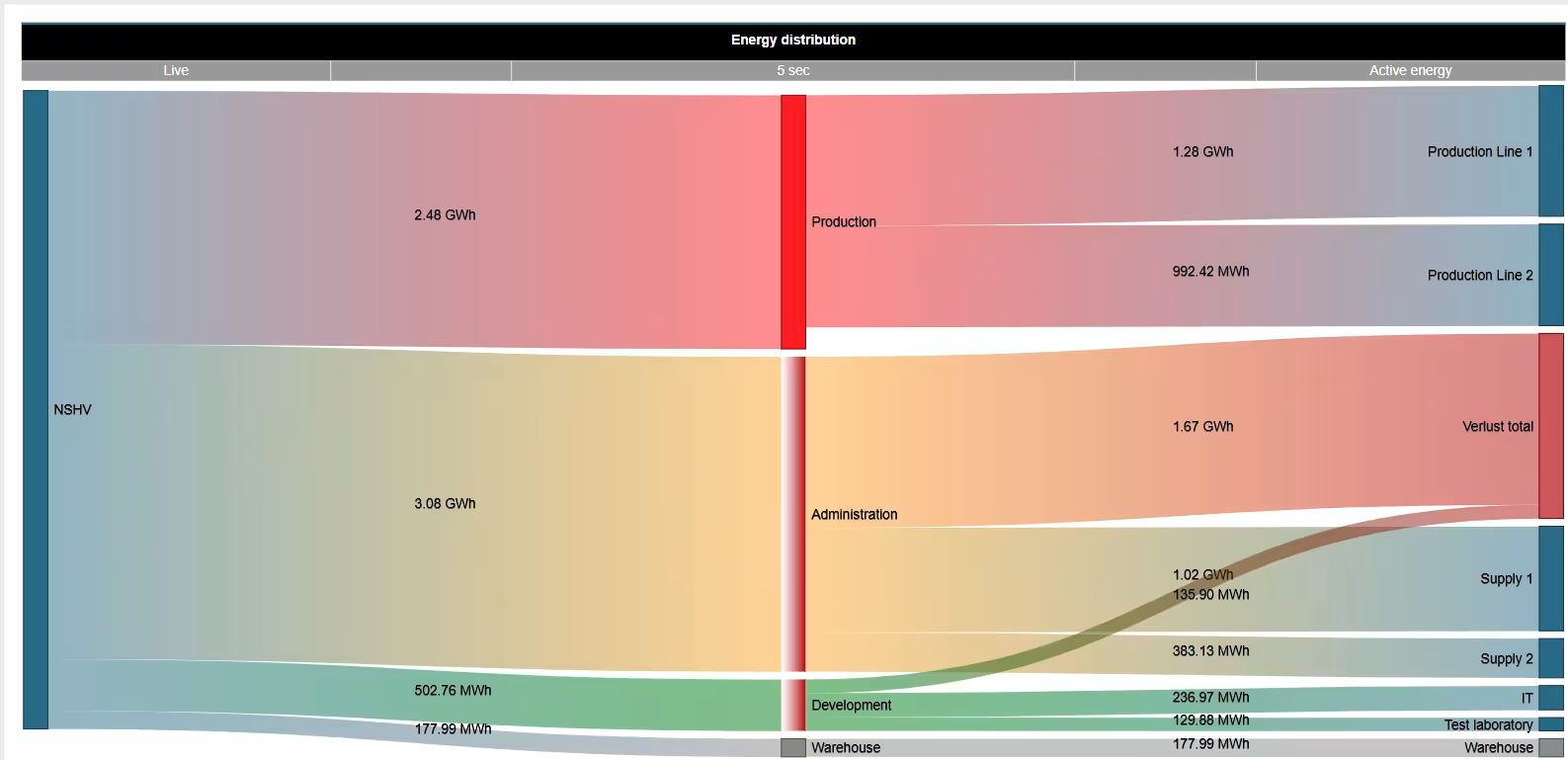
Developers must look past standard industry shorthand like Power Usage Effectiveness (PUE) or total Megawatts (MW), which mean very little to the public. Instead, utilize visual tools like a Sankey diagram to break down exactly where every kilowatt goes.
By presenting clear visual data, you can contextualize the facility's exact footprint for city leaders.
This baseline allows you to constructively compare your facility against high-energy local industries, such as Level 1 trauma centers or automotive plants.

Power Quality
Advanced Power Quality Monitoring (PQM) captures electrical anomalies like voltage sags, dips, swells, and harmonic distortion. To a city council, this sounds like pure engineering jargon.
When communities evaluate a new data center, they often focus strictly on total power consumption. But an equally critical question is how efficiently that power is used.
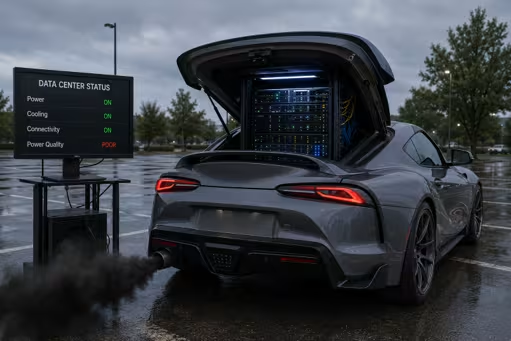
Operating a data center with poor power quality is a lot like driving a vehicle with black smoke billowing from the tailpipe. The car still starts, still moves, and still gets you to your destination. But that smoke is a warning sign.
It tells you that something isn't right under the hood. That not all of the fuel is being converted into forward motion. Whether caused by incomplete combustion or contaminated fuel, valuable fuel is being wasted.
Power quality issues create a remarkably similar challenge inside modern data centers. In the electrical world, power quality issues act as a silent killer of efficiency because standard facility dashboards simply lack the metrics to see this electrical black smoke happening in real time.
This challenge is magnified in the era of AI. AI factories feature highly dynamic workloads, causing power demands to fluctuate sharply, often by rates of 100kW in under 10 seconds.
In this context, an AI factory is a heavy vehicle constantly slamming on the gas, accelerating from 0 to 60 mph over and over. If the engine is already inefficient and smoking, that erratic driving causes energy waste and grid strain to skyrocket instantly. High-quality power monitoring ensures the engine runs completely clean, converting every kilowatt into useful work.
According to a recent survey compiled by DCD and Janitza, more than half (52%) of data center operators state that making data actionable after an electrical disturbance or power quality event is their single biggest challenge.
By demonstrating that your facility utilizes granular, microsecond-level data, you prove to municipal leaders that you are actively optimizing every operational lever.
It shows your AI factory is designed to cooperate with the local utility grid, not strain it.

Water, Air, Gas, Electricity, and Steam (WAGES)
Public concern rarely stops at electricity. To secure a long-term social license to operate, developers must widen their scope to account for all foundational resources, commonly tracked as WAGES: Water, Air, Gas, Electricity, and Steam.
Organizing and openly communicating your WAGES footprint allows you to build a verifiable credit report of industrial optimization. Instead of letting rumors dictate the narrative around local water tables or gas lines, present a transparent comparison of your resource efficiency against common commercial developments the town has already approved, such as large hotels, golf courses, or commercial manufacturing plants.
The recurring narrative around data centers is water usage, but U.S. golf courses use more than 500 billion gallons of water annually whereas data centers use 17 - 200 billion gallons per year with both direct and indirect usage. Beyond this, golf courses are used by a fraction of the population. The general public use applications that rely upon data centers every day.
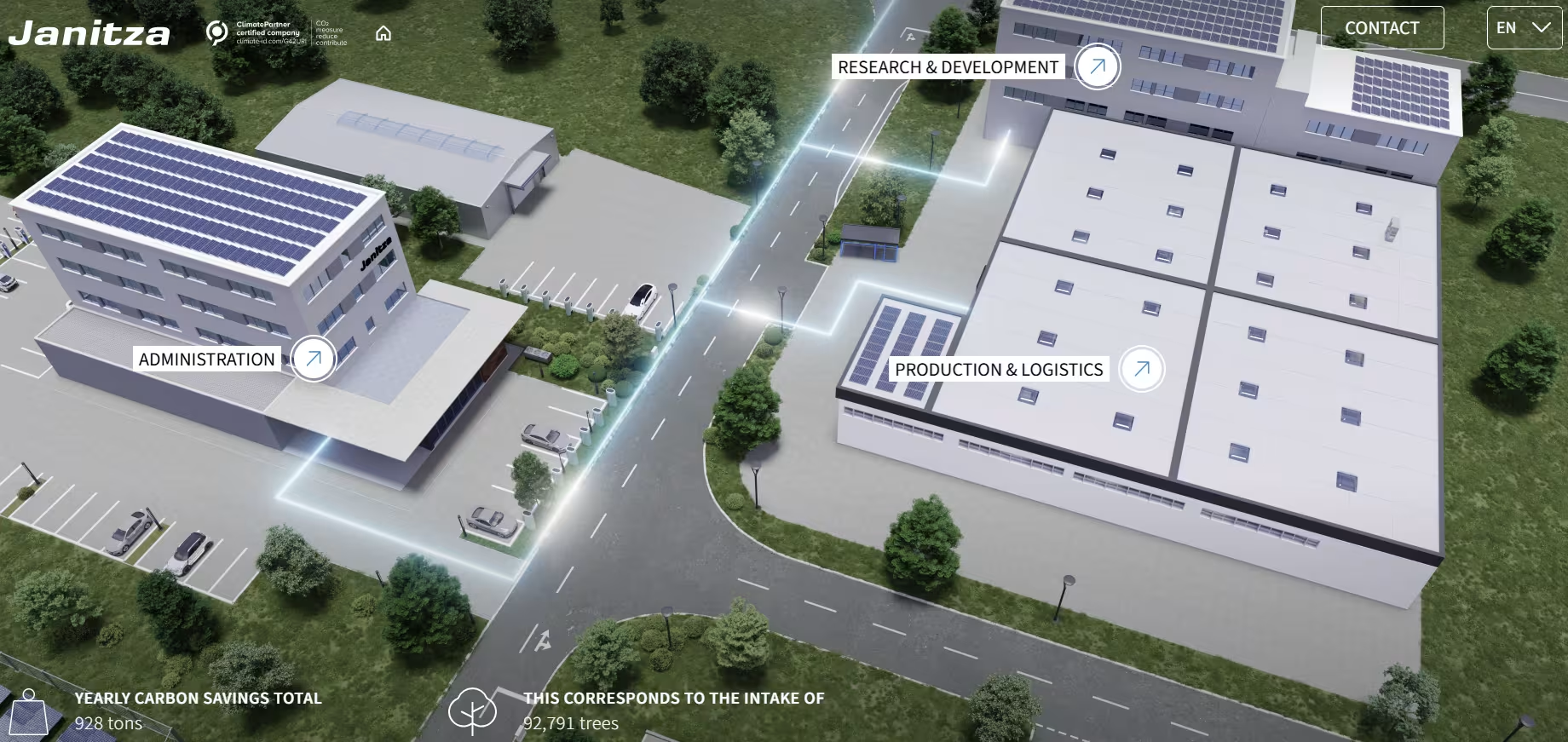
This level of resource transparency is precisely where Janitza can act as a strategic partner. Beyond providing the advanced hardware and visualization software needed to capture this data, Janitza leads the sector by example, executing a rigorous strategy to achieve operational carbon neutrality by 2030.
By prioritizing comprehensive resource transparency over mere baseline compliance, developers can shift the conversation away from what a data center consumes, focusing instead on the immense value it returns to the community.
Before the Next Municipal Meeting
When communities understand a data center as not merely as an isolated consumer, disconnected from our daily lives, but as the physical anchor for life-saving medical tech and everyday consumer conveniences, accurate data and storytelling offers meaningful context and the narrative shifts.
In a comprehensive global survey, DCD and Janitza interviewed 75 data center leaders to analyze exactly how infrastructure, investment, and community accountability strategies are shifting in 2026.
Since 1986, Janitza has focused on enabling long-term customer success as a forward-thinking, privately held manufacturer. When a customer brings us their requirements, our goal is simple. We look for a way to say yes.
Want help now? Connect with our experts at sales-us@janitza.com to accelerate your prep before the next municipal zoning meeting.